Disclaimer: As always, I am writing this in my personal capacity. The views expressed in this post are my own and do not represent the official position of the Bangor City Council or the City of Bangor.
We can all agree on a fundamental truth: our sidewalks must provide a safe, clear path for everyone to travel, but they also serve as our most traditional public squares.
Recently, the city has faced challenges with debris, materials, and items being stored on our sidewalks and esplanades, particularly in downtown Bangor. When sidewalks are blocked, pedestrians—especially those with mobility challenges—are sometimes forced to step off the curb and into the street to get around. Ensuring that our public walkways are safe, accessible, and clear is an incredibly important goal, and I fully support addressing it.
How we achieve that goal matters deeply.
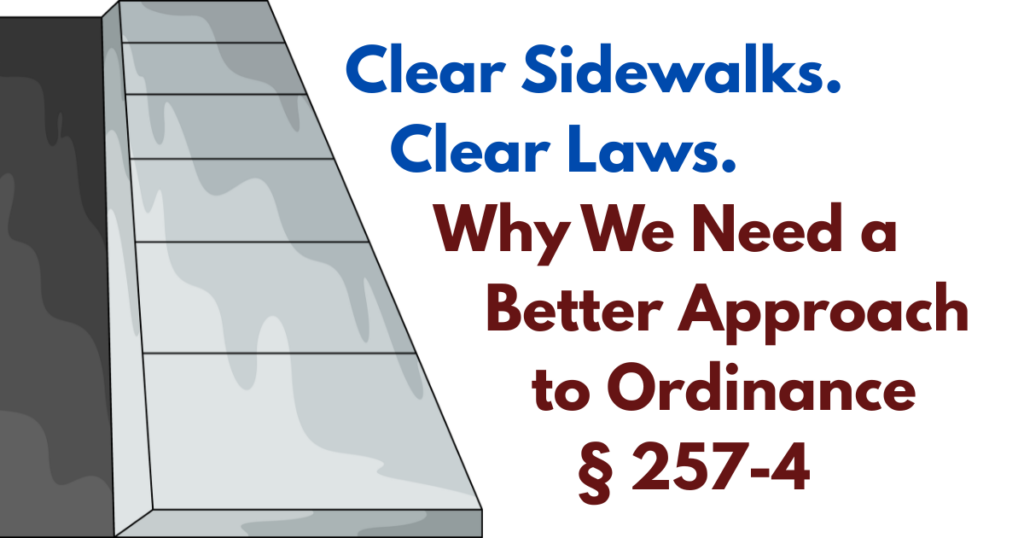
The current proposal before us is to amend Chapter 257, Section 257-4 of the City Code. Historically, this specific ordinance was written to regulate heavy construction staging. It requires anyone blocking the sidewalk to get a permit, assume legal liability, maintain a five-foot clearance, and build a “solid wood platform raised at least four inches above the roadway surface” complete with handrails.
The proposed fix is to simply delete the words “for construction purposes” from the ordinance so that it applies to the blocking of sidewalks with materials for any purpose.
I have serious concerns that this approach is constitutionally flawed. If Bangor City Council were to pass this as written, we are practically inviting a lawsuit. Here is why I voted no, and why I believe we need to send this back to the drawing board.
The “Three Words” Argument and Civil Penalties
During the Government Operations Committee meeting on Monday, an argument was made that this is a very small, simple change. It was suggested that because the ordinance has been on the books for decades without any constitutional issues, merely removing three words (“for construction purposes”) wouldn’t suddenly make it unconstitutional. It was also argued that because this would only be a civil penalty—not a criminal one—we shouldn’t worry too much about strict legal challenges.
I respectfully disagree. Removing those three words changes the entire reality of the law.
When you remove the context of “construction,” the word “materials” suddenly applies to absolutely anything. As was pointed out during committee debate, without a clear definition, a “material” could be a pile of bricks, a backpack, a protest sign, or a citizen parking a baby stroller on the sidewalk to watch a parade. Applying heavy-construction permitting rules—like requiring a citizen to build a raised wooden platform with handrails just to set down a legal item—is practically impossible for the average person to follow.
Furthermore, the idea that civil penalties are immune from strict constitutional scrutiny isn’t accurate. The Maine Supreme Judicial Court has made it clear that civil laws must still provide “reasonable and intelligible standards” so everyday people don’t have to guess at what is illegal. When an ordinance forces citizens to guess what constitutes a “material,” it is unconstitutionally vague.
The “Common Sense” Trap
When the baby stroller example was raised in committee, the response was essentially: don’t worry, our police officers will use their common sense and wouldn’t ticket someone for a stroller.
I have immense respect for the Bangor Police Department, and I trust their judgment. But relying on the subjective “common sense” of whoever happens to be on duty to save a poorly written law is a massive constitutional liability.
The United States Supreme Court has explicitly rejected this approach. In Chicago v. Morales, the Supreme Court struck down a municipal ordinance specifically because it gave police officers too much unlimited discretion to decide what conduct was prohibited and who should be prosecuted. A law cannot be written so broadly that it makes innocent conduct technically illegal, only to rely on the good grace of law enforcement to sort it out on the street.
Property Rights and the Unhoused Community
I think we need to be honest about what is really driving this. During the meeting, it was explicitly stated that this change is meant to address the “trash,” “debris,” and “items” left on sidewalks last summer.
When we talk about enforcing this against personal items left on the street, I believe we are directly talking about Bangor’s unhoused population.
Let’s be clear: we all have equal rights to the public sidewalk. It is genuinely not fair to pedestrians, especially our residents in wheelchairs, if the right-of-way is completely blocked by a huge shopping cart covered in a tarp. We absolutely have to maintain clear pathways. But there is a way we can balance everyone’s right to access the sidewalk without throwing away people’s property—or their rights. The ordinance, as amended, does not accomplish this and I know we can do better.
Federal courts have made it clear that unhoused individuals maintain a constitutionally protected possessory interest in their belongings—which often includes vital survival gear, medications, and irreplaceable personal effects. The Fourth Amendment protects individuals from the unreasonable seizure of their property. You cannot simply sweep up someone’s belongings and throw them away without due process, which requires advance notice and a way for the owner to retrieve their property.
The proposed Bangor amendment contains zero safeguards. It outlines no protocols for notice, safe storage, or retrieval. It merely empowers police to clear undefined “materials” using their “common sense”. With civil rights organizations like the ACLU already admonishing Bangor over loitering and median bans that target vulnerable populations, passing an ordinance that allows the summary seizure of an unhoused person’s only possessions is a catastrophic legal and ethical risk.
The First Amendment and the Portland Example
We don’t have to look far to see what happens when municipalities try to cast too wide a net over public spaces. Public sidewalks are considered “traditional public fora,” meaning citizens have deeply protected First Amendment rights to assemble and express themselves there.
In 2015, the City of Portland tried to ban standing or staying on median strips, arguing it was a common-sense measure for public safety. The federal appeals court for our region struck that ordinance down in Cutting v. City of Portland. The court ruled that the ban was unconstitutional because it wasn’t “narrowly tailored”—meaning it indiscriminately banned too much protected expressive activity (like holding political signs) to achieve its safety goals.
By requiring a government license for anyone to place any material on a sidewalk for any purpose, our proposed amendment falls into the exact same trap. It forces political organizers, union members, or street vendors to navigate a heavy-construction bureaucracy just to exercise their rights.
During our committee debate, the Chief of Police specifically named just three streets where this has been an ongoing issue—Cedar Street, First Street, and Harlow Street. The executive summary of the amendment itself points to a problem “especially in downtown Bangor”. But instead of taking the least restrictive path to fix a highly localized problem, we took the broadest possible approach, slapping a vague restriction on every single sidewalk and esplanade in the entire city.
Let’s Fix It, Not Force It
We absolutely need to address the very real accessibility hazards on our sidewalks. But we can achieve that goal without putting the city at risk of expensive civil rights litigation.
Instead of retrofitting an old construction ordinance, we should draft a new, specific section for general sidewalk obstructions. Rather than leaving the definition up to “common sense,” we can define an obstruction using objective, measurable standards—such as explicitly prohibiting items that reduce the clear path of travel to less than 36 inches, which perfectly aligns with the Americans with Disabilities Act (ADA) guidelines. We can also add clear exemptions for temporary, harmless uses and constitutionally protected speech.
Good intentions don’t make good laws; clear standards do.